

The forks clear the obstacle. The pallet has room. From the driver’s position, the turn appears straightforward.
Then the back of the forklift swings sideways.
Counterbalance forklifts steer from the rear, so the counterweight follows a different path from the front of the machine during a turn. In a generous warehouse aisle, that movement may be easy to accommodate. In a compact commercial work area, it can bring the rear of the truck much closer to parked vehicles, walls, stored goods or other parts of the premises than the customer expected.
For forklift hire and rent in Corinda, the intended turn deserves attention alongside the load and lift. The work does not need to become complicated. The customer simply needs enough room for the complete forklift movement, not just the forks travelling forward.
Customers often have a reasonable idea of where the forklift will enter and where the load needs to finish.
That can make the job look like a width question. If the truck fits through the available space, it seems as though the difficult part has already been solved.
Rear steering changes that assumption.
As the operator turns the steering wheels, the back of the forklift moves laterally. The tighter the manoeuvre, the more important that rear movement can become. A position that leaves comfortable clearance beside the forks may offer much less clearance beside the counterweight a moment later.
This is particularly relevant where the forklift has to turn close to a fixed object rather than travelling mainly in a straight line.
The hire conversation therefore benefits from knowing the tightest manoeuvre, not only the narrowest opening.
That information gives MLA Complete Forklift Solutions a clearer basis for considering the equipment around the load and the actual movement. The Brisbane forklift hire range includes equipment for different materials-handling roles, but physical suitability still comes back to what the customer needs the machine to do onsite.
Oxley Road gives Corinda a recognisable small-commercial setting. Retail and commercial premises can combine modest internal floor areas with on-site parking, rear working space and neighbouring activity.
A substantial delivery at a property like that may create a perfectly legitimate forklift requirement without resembling a large industrial yard.
A shop could be receiving equipment for a fit-out. A contractor may need to reposition palletised materials behind a commercial tenancy. A property customer might have one heavy item that needs controlled mechanical handling in a suitable private work area.
The load may only travel a short distance.
What matters is whether the forklift can complete the turn required within the space available.
That makes tail swing more than an abstract safety concept. It can determine whether a proposed equipment choice is practical for the customer’s actual Corinda job.
When a turn looks tight, three parts of the movement deserve separate attention.
The forks and load need enough room to reach the turning position without clipping stored items or forcing the operator into an awkward approach.
The load itself may affect visibility, so the operator needs to understand the space before committing to the manoeuvre.
This is where the rear of the forklift matters most.
The counterweight can sweep sideways while the front changes direction. Clearance beside the truck at the beginning of the turn does not guarantee the same clearance halfway through it.
People should also remain clear of that sweep area rather than treating the back of the machine as though it follows directly behind the forks.
Once the turn is complete, the forklift still needs enough room to line up with the load destination.
A manoeuvre that technically clears one corner but leaves no sensible way to straighten the machine has not solved the customer’s handling problem.
Looking at all three stages makes the equipment choice easier to understand without turning the job into a detailed traffic plan.

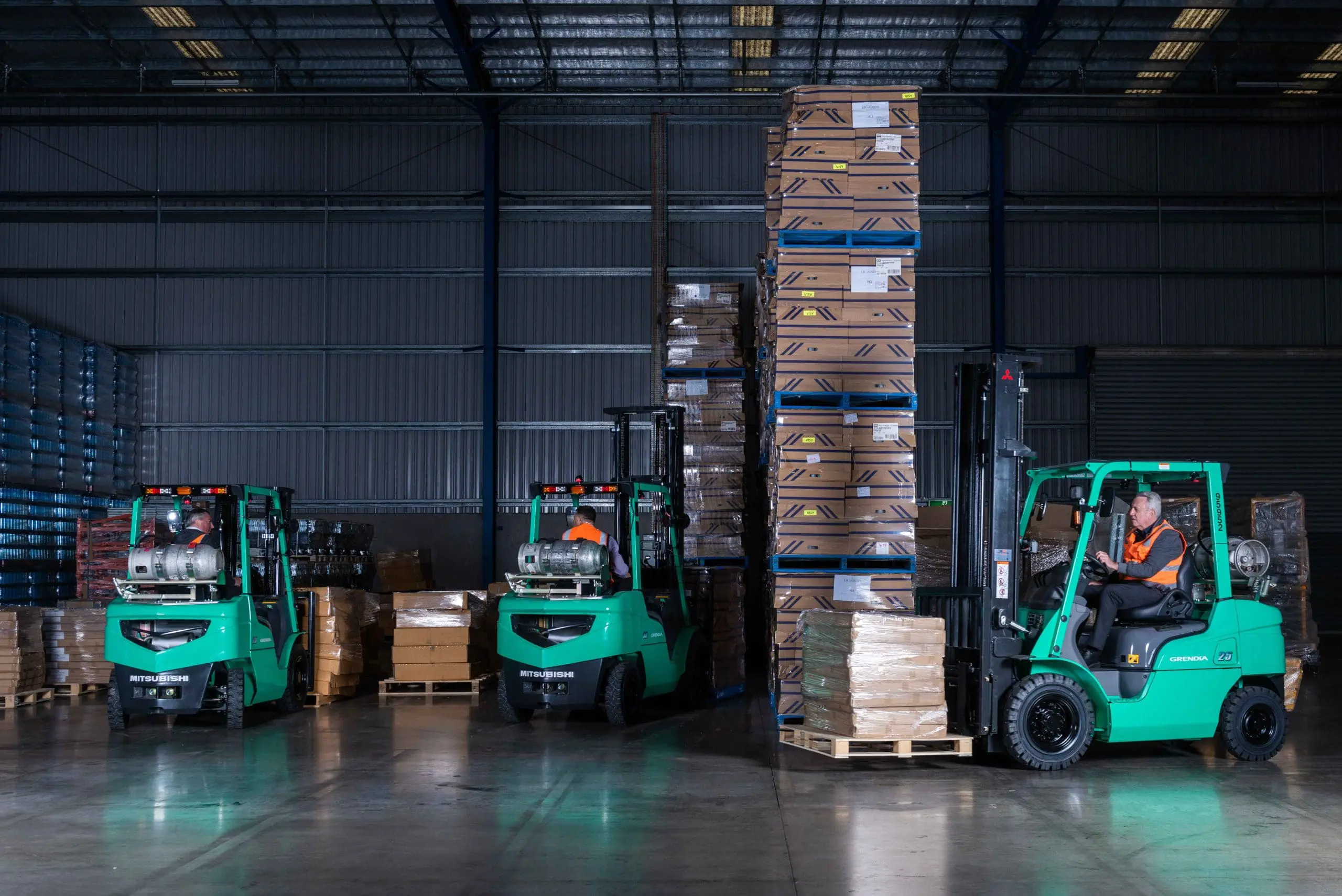
For a concentrated one-day job, the forklift may make the difficult turn only a handful of times. That still matters if every load has to pass through the same position.
During project rental, the manoeuvre can become part of the normal working cycle. A contractor handling repeated material deliveries may value equipment that is easier to position in the available area rather than repeatedly fighting the same turn.
Another Corinda business may bring in extra handling capacity during a busy stock period. The additional forklift should be assessed for the space it will actually use, particularly if the normal site equipment already occupies the easiest operating positions.
Where rental equipment is covering a role usually performed by another machine, rear movement should also be considered on the hired truck itself. Similar capacity does not guarantee identical steering behaviour or dimensions.
Longer rental adds another reason to get the fit right early. A manoeuvre that feels inconvenient once can become a daily frustration when it is repeated for months.
Tail swing assumes the forklift responds normally to the operator’s steering input.
A truck that feels inconsistent, unusually loose or different from its normal steering behaviour needs attention rather than a larger safety margin around the turn.
Operators should be familiar with the forklift they are using and complete the relevant pre-start checks before work begins. Damage affecting tyres, steering components or other parts involved in controlled movement should be reported.
Where a forklift requires mechanical assessment, MLA’s service and repair support covers suitable servicing and repair requirements. Parts should follow the actual fault and equipment involved rather than an assumption based on how the machine feels from the driver’s seat.
The customer benefit is straightforward: a tight turn is much easier to manage when the forklift behaves predictably.


For a Corinda job with limited manoeuvring space, describe the point where the forklift needs to change direction rather than focusing only on the doorway or load destination.
The load weight, lift height and working surface still determine fundamental equipment requirements. The turning movement adds the spatial information needed to understand whether the truck will work comfortably once it starts manoeuvring.
MLA’s contact team can assess the requirement around that complete movement.
The right result is easy to recognise on-site: the load reaches its position without the operator discovering halfway through the turn that the back of the forklift needs space nobody allowed for.
Not automatically. Overall dimensions, steering geometry and the particular forklift configuration all influence how the machine moves. The proposed manoeuvre should be considered against the actual equipment rather than size alone.
That solves only the load-clearance part of the movement. The rear of a counterbalance forklift can move outside the apparent path of the forks during a turn, so the whole truck needs enough room.
Yes. One substantial delivery can still require a tight turn. Customers do not need a permanent warehouse operation before equipment fit becomes important.










